

Helsinki, Finland Travel & Design Guide
What Helsinki Taught Me About Architecture, Design—and Homes
By John Bertsch, REALTOR®, Coldwell Banker West
I had wanted to visit Helsinki for years. I finally got my chance during a recent trip with my better half, centered around visiting his nephew in Sweden. Finland became our very worthwhile detour—and for someone fascinated by history, architecture and urban design, Helsinki felt less like sightseeing and more like being turned loose in a particularly elegant laboratory.
Finland has long batted above its weight in architecture and design. The country is not flashy. It is restrained, practical and deeply attentive to the relationship between people and nature. In Helsinki, that philosophy is not confined to museums or expensive objects. It turns up in buildings, streets, handrails, furniture—and, apparently, nearly every bathroom.
A Compact Capital Designed Around People
Helsinki is compact, walkable and remarkably courteous to pedestrians. Drivers routinely yielded as we crossed the street. Many cobblestone streets are narrow, often accommodating just one lane in each direction and perhaps a row of parallel parking. The result is a city scaled to the person walking through it rather than to the automobile muscling across it.
By European standards, Helsinki is not especially old. The city was founded in 1550 and became the capital of the autonomous Grand Duchy of Finland in 1812—not 1821, as I had originally remembered it. Much of the architecture that gives central Helsinki its personality arrived around the turn of the 20th century: Finnish National Romantic and Jugendstil buildings with fanciful stonework, expressive lettering and details that can make an ordinary block feel a little like a fairy tale.


Hotel Lilla Roberts: A Very Comfortable Headquarters
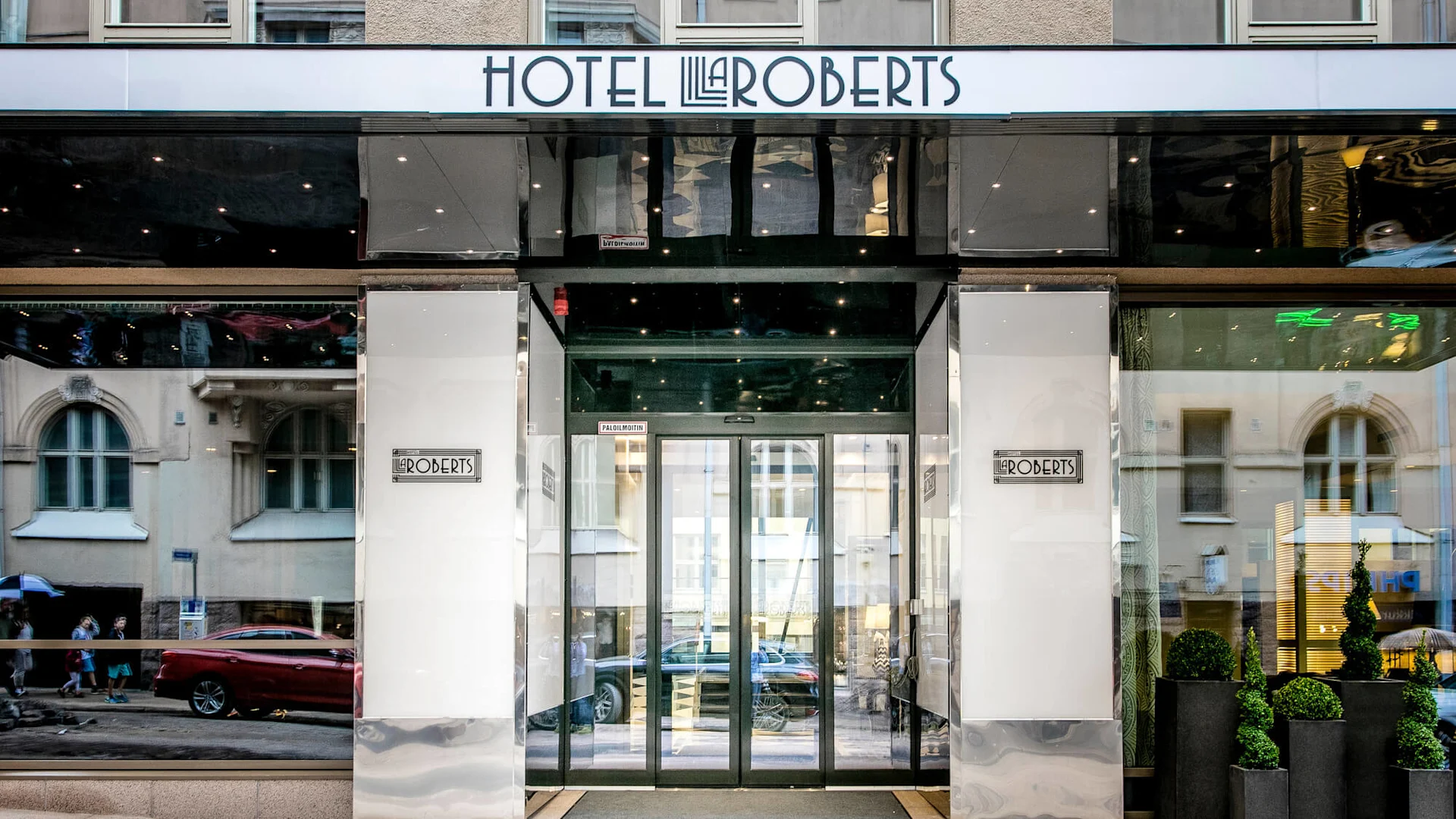
You could do a great deal worse than Hotel Lilla Roberts, our home base in the Design District. The handsome lobby and bar set the tone, but the room won me over: sleek, modern and unusually spacious. The bathroom had a heated floor, a bathtub long and deep enough to accommodate my 6-foot-4-inch frame, and a bidet. It is a hotel I would happily recommend.
The included breakfast buffet seemed determined to represent every possible interpretation of breakfast: hot dishes, cold dishes, local specialties and, yes, pickled herring. I had a piece. The dining room’s large windows faced a narrow but bustling street, while an abundance of design shops waited just outside.
Speaking of bidets, we did not encounter a single restaurant, shop, sauna or hotel bathroom without one. Talk about civilized. Finland has apparently decided that personal comfort is a public good.

Address: Hotel Lilla Roberts, Pieni Roobertinkatu 1–3, 00130 Helsinki, Finland.
Day One: Finnish Architecture and Design
We devoted our first day to the Architecture and Design Museum, just a few blocks from the hotel. Its exhibitions offered an excellent introduction to the Finnish belief that good design should be beautiful, useful and humane—three qualities that do not always travel together.
A major focus was Finland’s most celebrated modern architect, Alvar Aalto, whose work has influenced the way I think about houses and the people who live in them. Aalto did not create beauty merely to be admired. He designed around the physical and emotional needs of the person using a room.

Address: Architecture and Design Museum, Korkeavuorenkatu 23, 00130 Helsinki. Accessible entrance: Ullanlinnankatu 4.
Day Two: Sauna, Seawater and a Sudden Increase in Machismo
The highlight of our second day was Allas Sea Pool, a public sauna and swimming complex directly on Helsinki’s waterfront. It has saunas, pools, a sun deck, a café and splendid views across the harbor. We arrived in the late afternoon as office workers were ending their day, which made the place feel less like a tourist attraction than a well-used neighborhood ritual.
And, yes, I got into the cold seawater pool.
The water was about 58 degrees—not literally icy, although it heads toward a far more alarming temperature in winter. I stayed in for seven minutes, which surprised no one more than me. In all my years in San Diego, I have refused to enter the Pacific when it dips below 68 degrees, and even then I regard a minute or two as evidence of character. After seven minutes in Helsinki, I now consider myself quite butch.
Address: Allas Sea Pool, Katajanokanlaituri 2A, 00160 Helsinki.
Finland, Russia and the Flags of Ukraine
Before the trip, my friend and neighbor Helena loaned me History of Finland in a Nutshell, a compact and very useful primer. Finland’s relationship with its enormous eastern neighbor has been long and complicated. The country was part of the Russian Empire from 1809 until declaring independence in 1917.
Russia’s full-scale invasion of Ukraine brought that history sharply into the present. Finland applied to NATO in 2022 and formally joined the alliance on April 4, 2023. Throughout Helsinki we saw Ukrainian flags—including outside City Hall—a visible statement of sympathy and political alignment that was difficult to miss.
Address: Helsinki City Hall, Pohjoisesplanadi 11–13, 00170 Helsinki.
Day Three: A Market, a Monumental Station and the Rock Church
We began the third day around Helsinki’s markets, where Finnish food culture is presented without ceremony but with plenty of temptation. And then, in a neighborhood grocery, in the midst of all that Nordic sensibility, I spotted an entire Tex-Mex section. It just goes to show that Texas is never very far away.

Address: Old Market Hall (Vanha Kauppahalli), Eteläranta, 00130 Helsinki, beside Market Square.
From there we walked through Helsinki Central Railway Station, designed by Eliel Saarinen and opened in 1919. I have always loved railway stations—the soaring spaces, the promise of departure, the faint sense that everyone is in the first act of a mystery. Saarinen’s station combines monumental stone, bold geometry and sculptural figures in a style more accurately described as Finnish National Romantic moving toward modernism than as conventional Art Deco.

Address: Helsinki Central Railway Station, Kaivokatu 1, 00100 Helsinki.
Next, we went to Temppeliaukio Church, universally and sensibly known as the Rock Church. Designed by brothers Timo and Tuomo Suomalainen and completed in 1969, the sanctuary is excavated directly into solid bedrock.

The rough stone walls remain exposed. Above them, narrow bands of glass bring daylight beneath a broad copper-lined dome. The effect is both dramatic and restrained. Your eye rises toward the ceiling, but the horizontal sweep of the rock keeps bringing your attention back to the earth. It is not Gothic architecture, though it produces some of the same emotional effects: filtered light, acoustic richness and a sense of being lifted beyond the ordinary.
Address: Temppeliaukio Church, Lutherinkatu 3, 00100 Helsinki. Public access varies around services, concerts and special events, so check the church calendar before visiting.
Alvar Aalto and the Architecture of Empathy
Aalto’s famous Paimio Sanatorium, designed with Aino Aalto and completed in 1933, may be the clearest expression of his human-centered philosophy. The tuberculosis patient was not an abstract “user.” The patient was a real person who spent much of the day lying horizontally. Aalto therefore considered the room from the bed: ceiling colors were selected to be calming, lighting was arranged to avoid glare and fixtures were designed to minimize noise.
That same care appeared in details as small as handrails. Aalto shaped things to fit the human hand and body—not merely to photograph well. Lighting, furniture, sinks, door handles and circulation all contributed to the experience of comfort and recovery.
Address: Paimio Sanatorium, Alvar Aallon tie 275, 21540 Paimio, Finland. It is outside Helsinki, near Turku, and is best treated as a separate excursion.
What Helsinki’s Design Can Teach Us About a Home
Aalto’s ideals have always informed mine, and they influence what I notice when I walk through a house with a buyer or advise a seller about improvements. A beautiful room that ignores how a person moves, rests, cooks or gathers is only doing half its job.
The best homes rarely announce their intelligence. They simply feel right. A window catches useful light. A railing fits the hand. A doorway creates a natural path instead of a collision. Rooms support the lives taking place inside them. Helsinki is full of this sort of quiet intelligence.
That may be the most useful real-estate lesson I brought home: good design is not decoration added at the end. It is the accumulated effect of hundreds of decisions that respect the person who will live there.
Is Helsinki Worth Visiting?
Absolutely. Helsinki is especially rewarding for travelers interested in architecture, urban design, saunas, history and the small details that make city life work. It is easy to navigate, compact enough to explore on foot and full of buildings that reward a second look.
Finland has repeatedly ranked at the top of the World Happiness Report. After visiting, I would not reduce that achievement to cheerful people skipping down the street—Finns are rather more restrained than that. The happiness seems embedded in something quieter: trust, competence, access to nature and a shared expectation that public and private spaces should serve people well.
Plan a trip. Prepare to be charmed. Try the herring. Use the bidet. And if you enter the cold pool, seven minutes is apparently the amount of time required to become insufferably proud of yourself.
Helsinki Architecture and Design: Quick Visitor Guide
- Hotel Lilla Roberts: Pieni Roobertinkatu 1–3, 00130 Helsinki
- Architecture and Design Museum: Korkeavuorenkatu 23, 00130 Helsinki
- Allas Sea Pool: Katajanokanlaituri 2A, 00160 Helsinki
- Helsinki City Hall: Pohjoisesplanadi 11–13, 00170 Helsinki
- Old Market Hall: Eteläranta, 00130 Helsinki
- Helsinki Central Railway Station: Kaivokatu 1, 00100 Helsinki
- Temppeliaukio Church: Lutherinkatu 3, 00100 Helsinki
- Paimio Sanatorium: Alvar Aallon tie 275, 21540 Paimio
Frequently Asked Questions About Visiting Helsinki
Is Helsinki a walkable city?
Yes. Central Helsinki is compact, pedestrian-friendly and well served by trams. Several major attractions—including the Design District, Market Square, Old Market Hall and Central Railway Station—can be connected easily on foot.
What is Helsinki’s Rock Church?
Temppeliaukio Church is a modern Lutheran church excavated into natural bedrock. Completed in 1969, it is known for its exposed granite walls, copper dome, radial skylights and excellent acoustics.
Where can visitors experience a Finnish sauna in Helsinki?
Allas Sea Pool offers waterfront saunas, heated pools and a seawater pool beside Helsinki’s Market Square. It is convenient for first-time visitors and popular with residents.
Why is Alvar Aalto important?
Alvar Aalto was a leading Finnish modernist whose architecture, furniture and objects emphasized human comfort, natural materials and the emotional experience of a space. Paimio Sanatorium is one of the clearest examples of his patient-centered design.



GET MORE INFORMATION