

Stockholm: So Much for Scandinavian Restraint
Stockholm: So Much for Scandinavian Restraint
Islands, spires, architectural extravagance, and a dog with something to say
After several wonderful days in Helsinki and Gothenburg, we arrived in Stockholm, the final stop on our Scandinavian adventure. I’d been impressed by Helsinki’s restrained architecture and Gothenburg’s charming pedestrian streets, but Stockholm turned out to be something quite different.
When I think of Scandinavian design, I think of simplicity. Clean lines, minimal ornamentation, Danish modern furniture, IKEA. The philosophy that less is more, and anything decorative had better have a very good reason for being there.
Clearly, Stockholm didn’t get the memo.
This is a grand European city, much more reminiscent of Paris than the spare, restrained architecture I associate with Nordic design. Its buildings are richly ornamented, with elaborate façades, decorative rooflines, towers, domes, cupolas, and spires. Everywhere I looked, there was something interesting to see. I was utterly charmed.
A Less-Than-Promising Arrival
But our introduction to Stockholm wasn’t particularly auspicious. We arrived at the NOFO Hotel in Stockholm’s Södermalm neighborhood and I promptly collapsed on the bed for a couple of hours By the time we ventured outside, the sun was setting.
I hadn’t realized that our hotel was in a quieter part of the neighborhood. The streets were broader than I’d expected, with plenty of automobile traffic but surprisingly little pedestrian activity. We wandered around looking for somewhere lively to have dinner, but the streets seemed practically deserted. Several restaurants were closed, and there wasn’t much evidence that anyone was particularly interested in going out.
It was Monday evening, which probably explained some of the inactivity. But after the lively pedestrian streets of Gothenburg, I was disappointed. This was Stockholm? Sweden’s magnificent capital?
Fortunately, the following morning was an entirely different story.
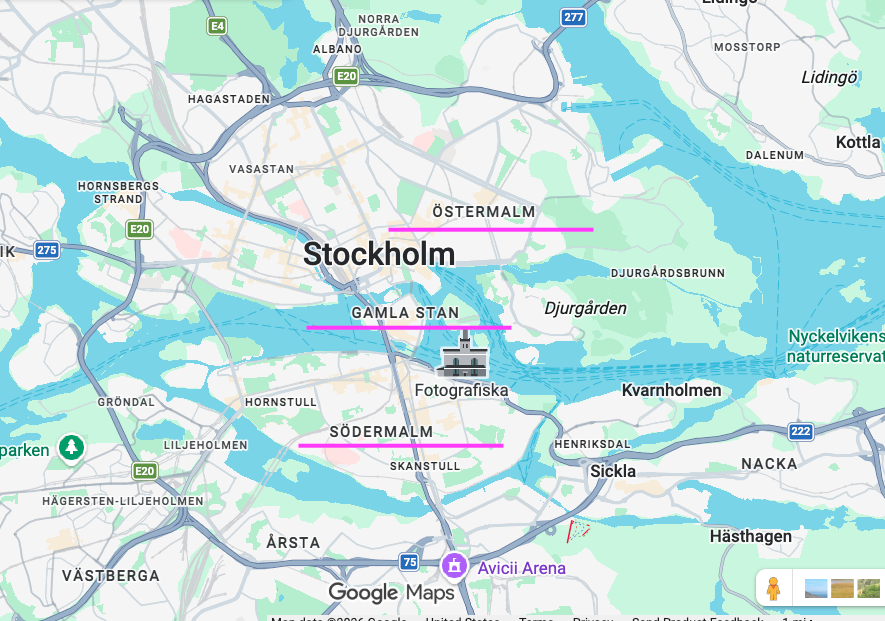
Central Stockholm is spread across several islands. We stayed in Södermalm, a short walk from historic Gamla Stan. Östermalm, another architectural treasure trove, lies to the northeast.
Stockholm Reveals Itself
The following morning was clear and sunny, and we set off toward Gamla Stan, Stockholm’s historic center. It was only about a ten-minute walk from our hotel, but the transformation was remarkable. We were suddenly surrounded by some of the most enchanting architecture I’ve ever encountered.
Stockholm is built across a series of islands connected by bridges, with waterways running between them. Some islands rise steeply above the water, creating dramatic changes in elevation and wonderful opportunities to look across the city. From one vantage point, you might see a cluster of towers and domes rising above the rooftops. Turn a corner, and an entirely different collection of buildings appears across the water.
And the streets! Unlike cities laid out on an orthogonal grid, where you can often see several blocks ahead, historic Stockholm follows a typical irregular medieval street pattern. Streets bend, narrow, widen, and intersect at unexpected angles. Buildings suddenly come into view, and little squares appear where you least expect them.
For someone who loves architecture and urban design, this was heaven. The city was full of surprises, and nearly every corner offered another visual delight.
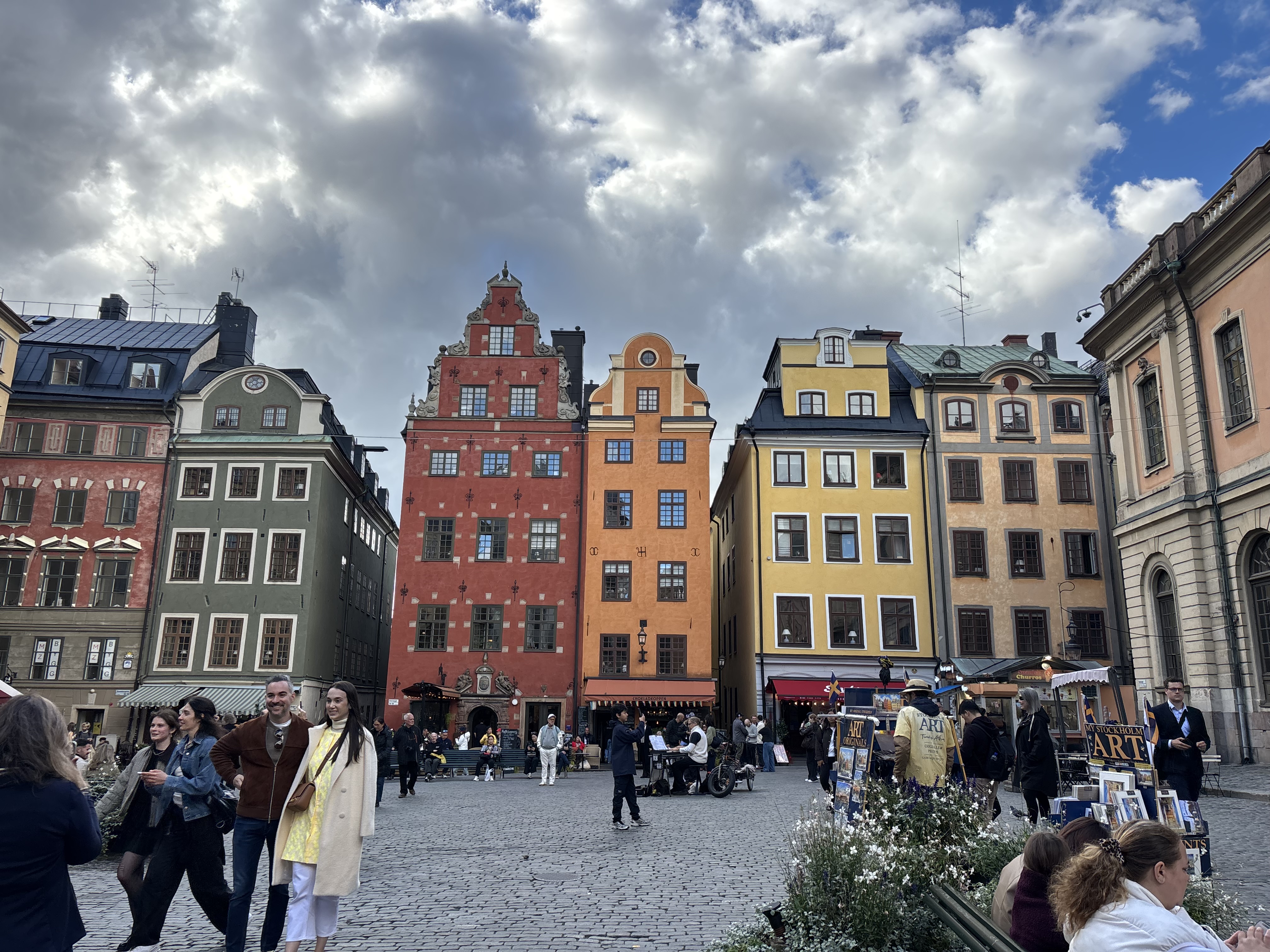
Some of the most charming architecture you’ll ever find. Stockholm’s historic streets and squares are filled with architectural surprises.
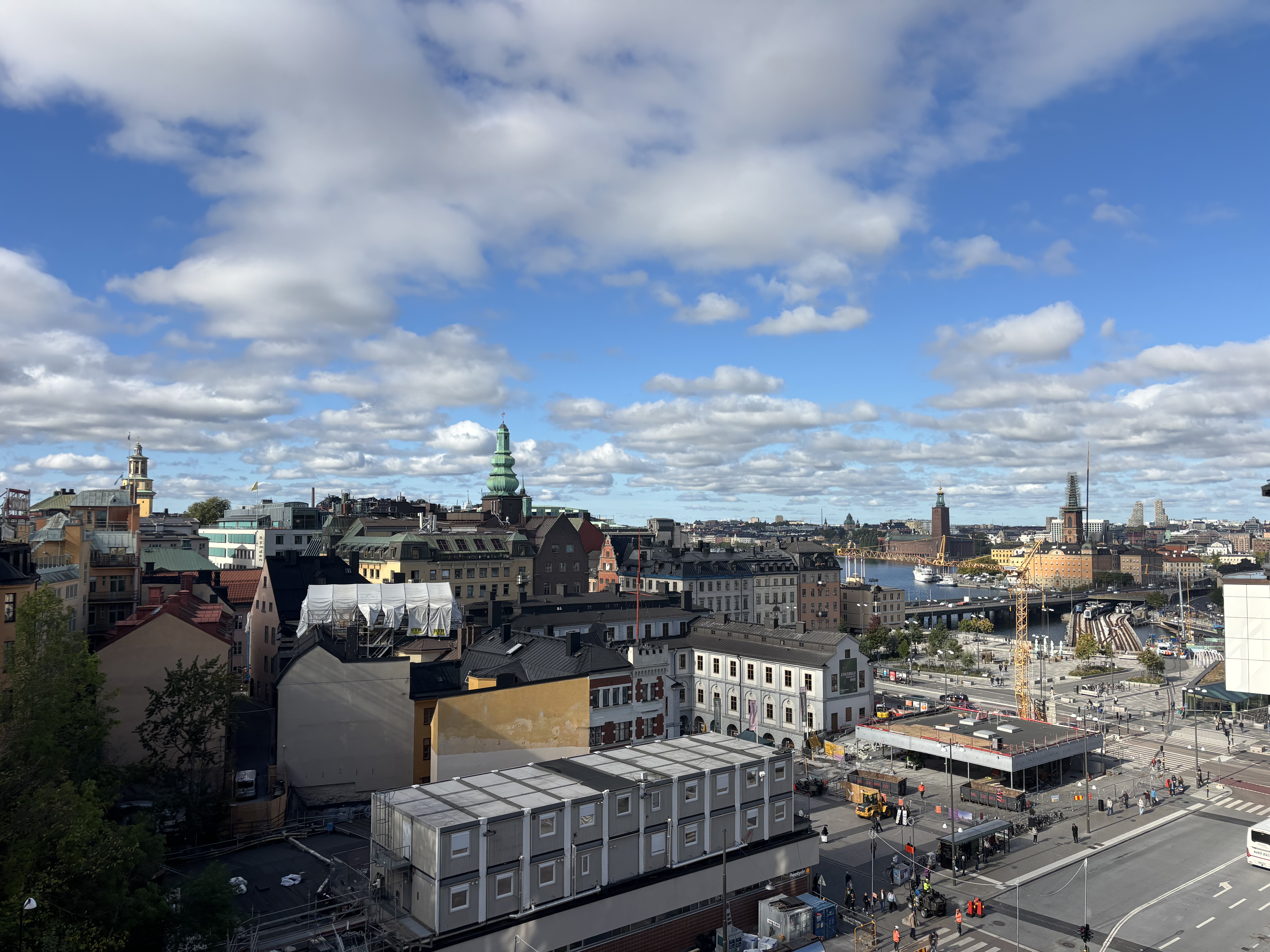
Stockholm’s islands, waterways, and extraordinary rooflines create an ever-changing cityscape.
So Many Domes, Cupolas, and Spires!
The very first thing I noticed was the extraordinary number of domes, cupolas, towers, and spires. It seemed as though every other building had something interesting happening above the roofline.
And these weren’t necessarily churches or government buildings. Decorative towers and elaborate rooflines appeared on commercial buildings, apartment houses, and all sorts of other structures.
These architectural features served a variety of purposes over the centuries. Church spires and civic towers expressed religious, political, or institutional importance. On commercial and residential buildings, elaborate rooflines often reflected the architectural fashions of their time, the ambitions of their owners, or simply a desire to create something distinctive. In a city spread across islands, they also became useful landmarks, easily recognizable from across the water.
Whatever their original purpose, the cumulative effect is extraordinary. Stockholm has one of the most interesting skylines I’ve ever seen, not because of its height, but because of the remarkable variety of shapes and silhouettes.
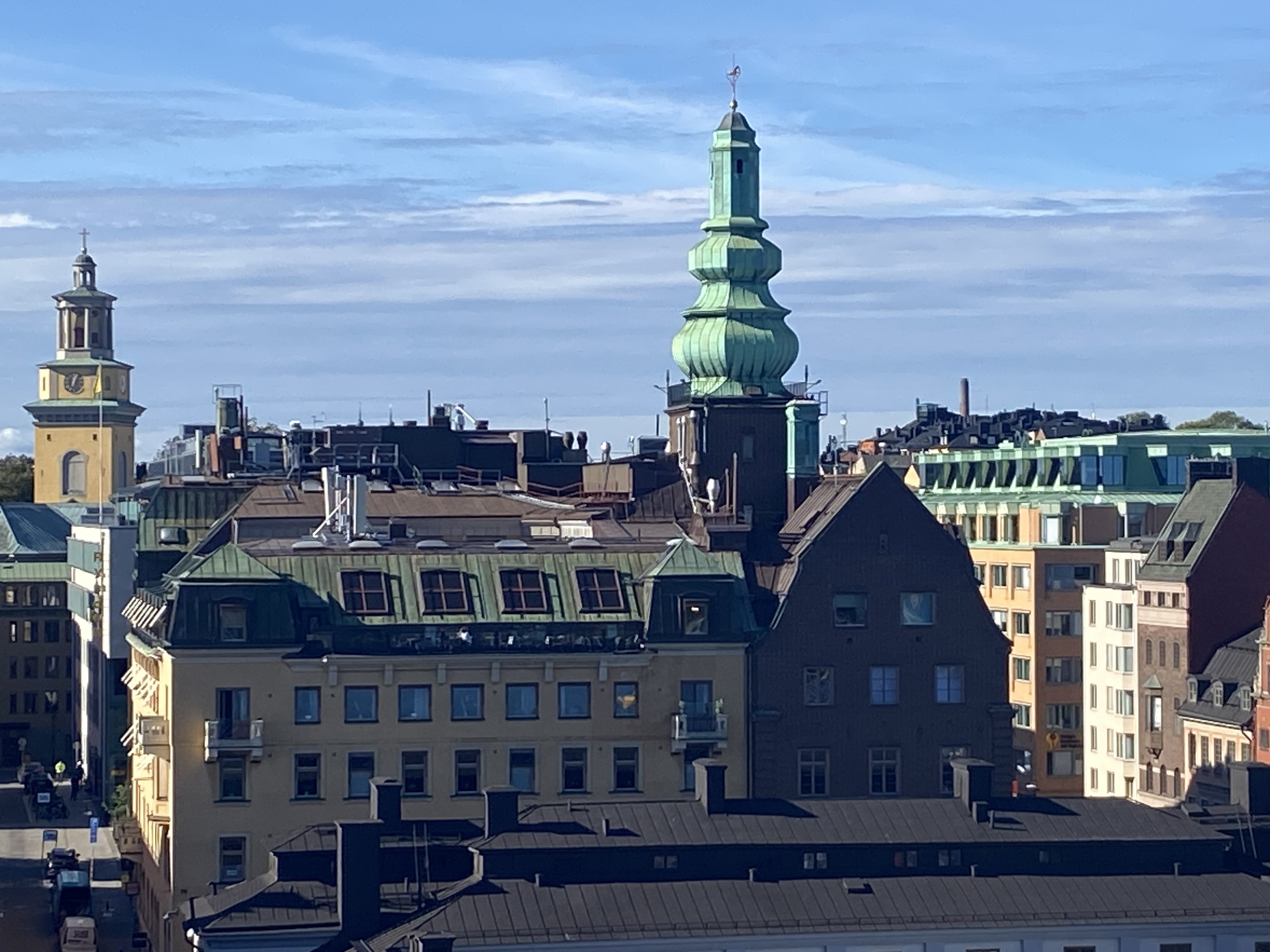
Spires and cupolas everywhere! Stockholm’s rooflines are almost as interesting as the buildings beneath them.
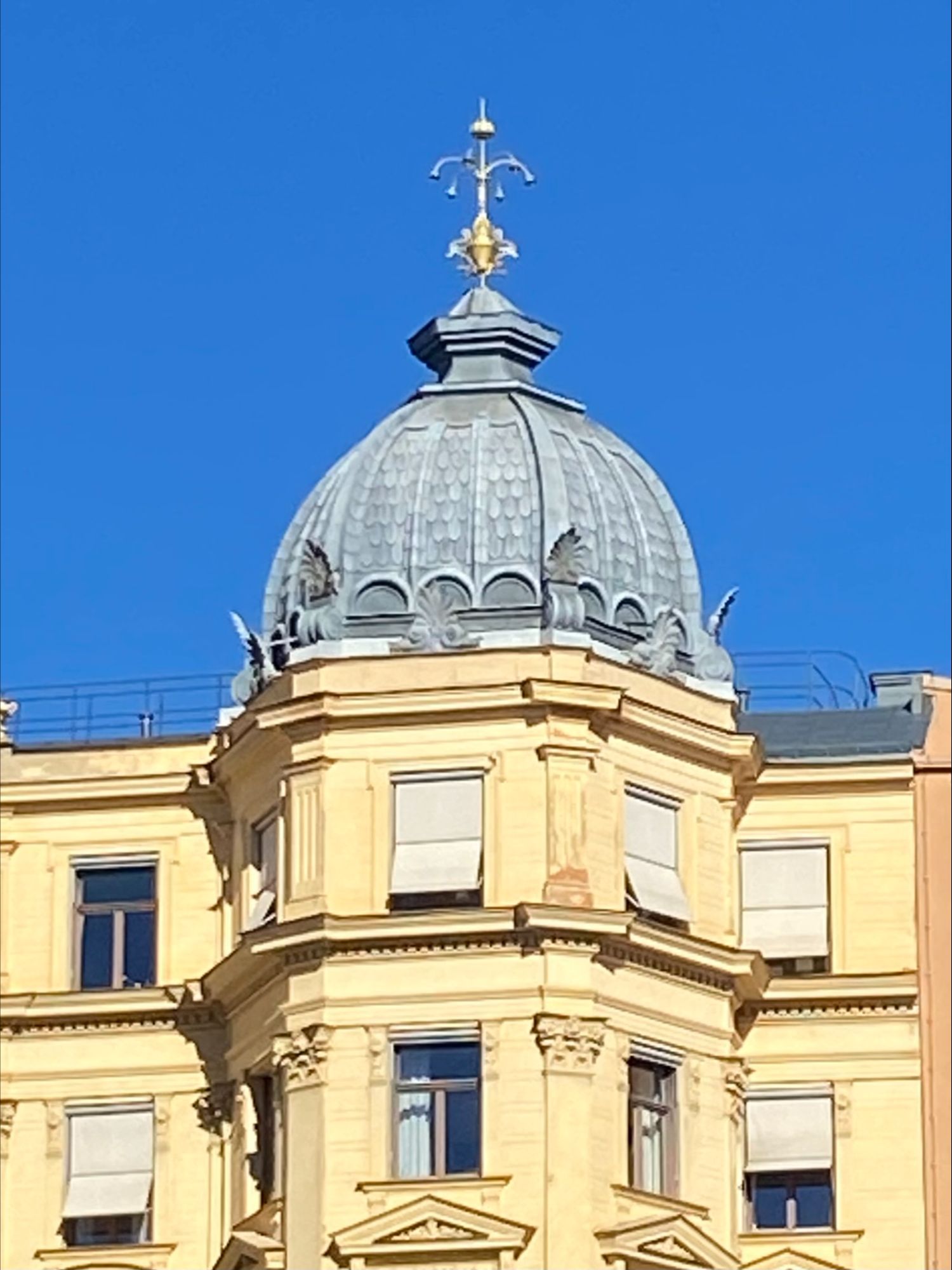
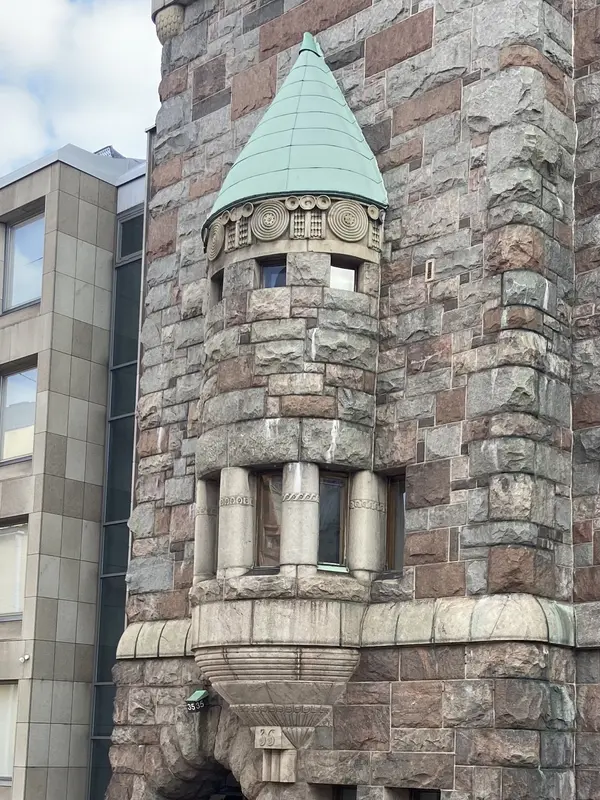
Elaborate stonework, balconies, and a magnificent corner tower. Stockholm has no shortage of architectural eye candy.
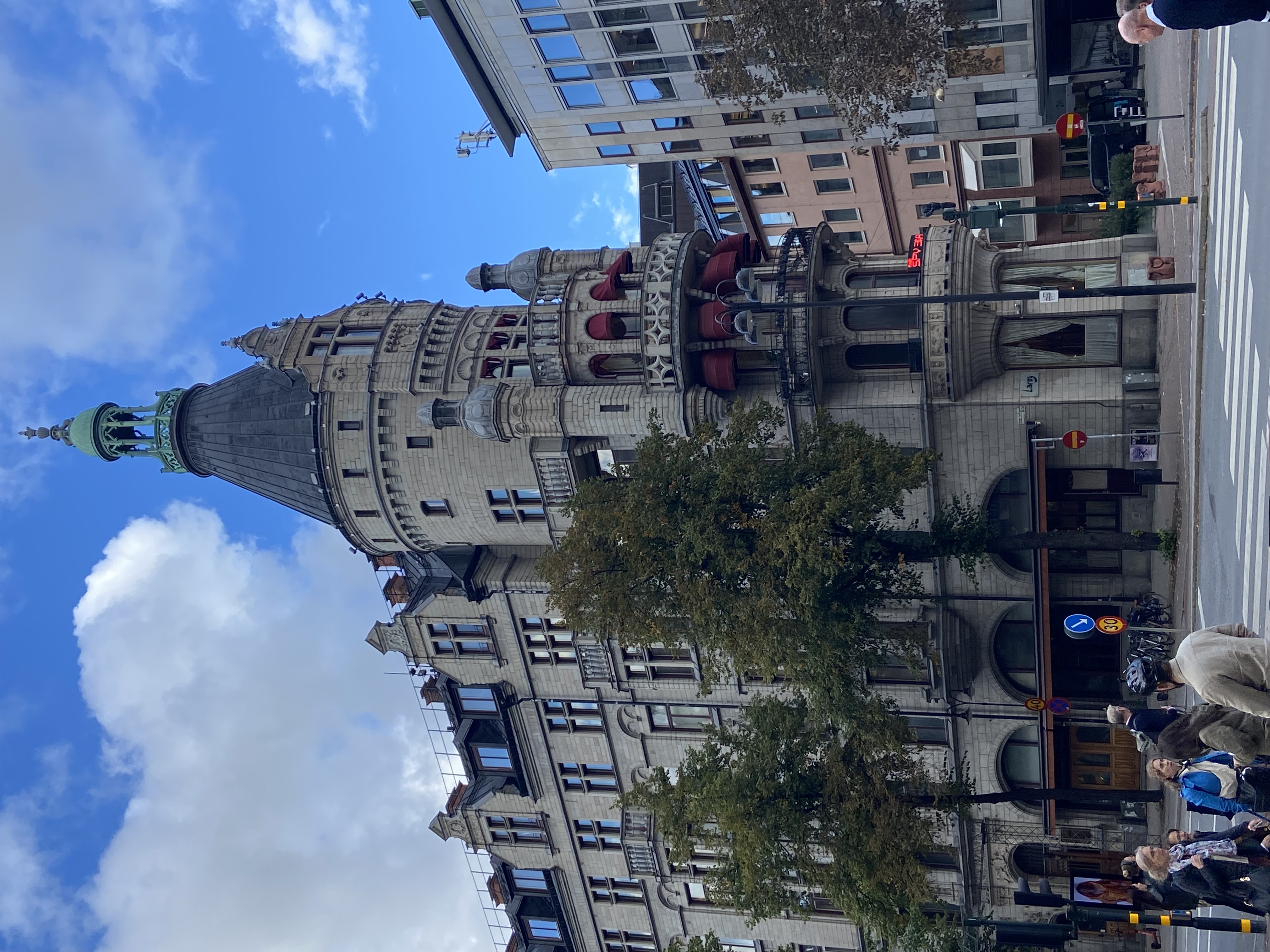
Another magnificent dome. Stockholm never met a roofline it couldn’t embellish.
National Romanticism: Architecture with a Swedish Accent
Some of Stockholm’s most distinctive buildings belong to an architectural movement known as National Romanticism, which flourished in Sweden and other Nordic countries during the late nineteenth and early twentieth centuries.
During this period, architects were looking for a distinctly national architectural identity rather than simply reproducing styles imported from elsewhere in Europe. They drew inspiration from medieval buildings, traditional craftsmanship, historic castles, and local building materials. In Sweden, this often meant substantial brick or stone buildings, steep roofs, towers, and carefully composed silhouettes.
Stockholm City Hall is one of the best-known examples. Designed by architect Ragnar Östberg and completed in 1923, it’s a monumental brick building with a distinctive tower rising above the waterfront. Its architecture draws on several historical influences, including Italian civic buildings, but the overall composition is unmistakably Swedish.
Of course, not every dome or spire in Stockholm belongs to National Romanticism. The city’s architectural character developed over centuries, incorporating Renaissance, Baroque, Neoclassical, Art Nouveau, National Romantic, and other influences. That’s part of what makes it so visually rich.
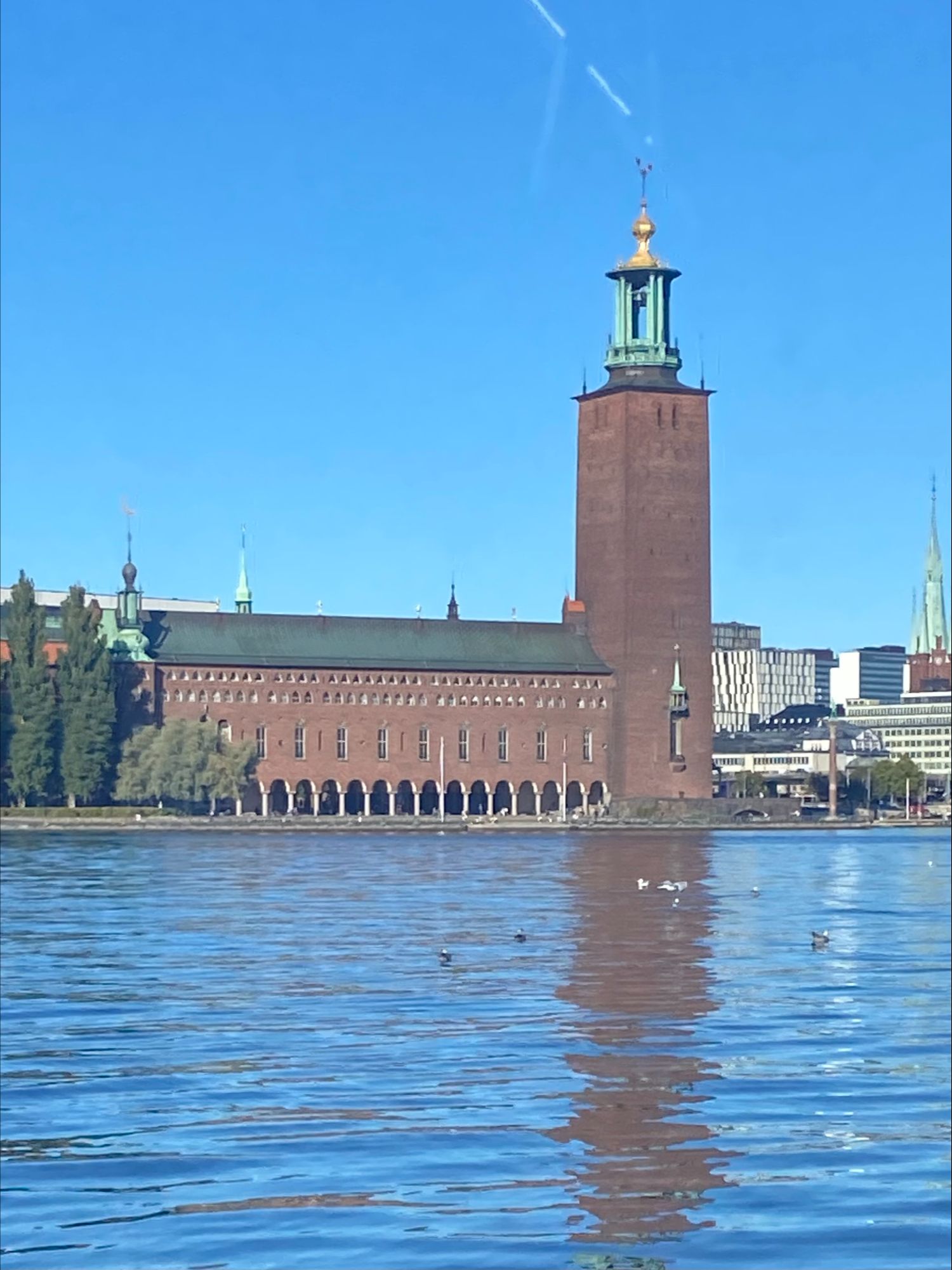 Stockholm City Hall, completed in 1923, is one of Sweden’s great examples of National Romantic architecture. And, naturally, another magnificent tower.
The Royal Palace, a Changing of the Guard, and One Opinionated Dog
While exploring Gamla Stan, we happened upon the changing of the guard outside the Royal Palace. The palace is an enormous eighteenth-century building, and the surrounding public spaces are impressive. The architecture is formal and monumental, with broad paved areas framed by substantial classical buildings.
My shameful secret: after all these years of traveling and appreciating architecture, I’ve never been in an actual royal palace! We didn’t go inside this one either. I was perfectly happy admiring the architecture and urban design of the surrounding spaces.
We joined a crowd of perhaps fifty people watching the ceremony. The soldiers marched with the rigid precision you’d expect, while their commanding officers barked out instructions in Swedish.
And then there was this dog.
Someone in the crowd was accompanied by a dog who apparently felt that the commanding officer needed a little assistance. Every few commands, just as the officer finished shouting something, the dog would respond with a short, emphatic bark. It was almost a call-and-response performance. The officer shouted. The dog barked. A few more shouts. Nothing. The officer shouted again. Another bark. I don’t imagine the officer found it particularly amusing. I, on the other hand, had considerable difficulty keeping a straight face.
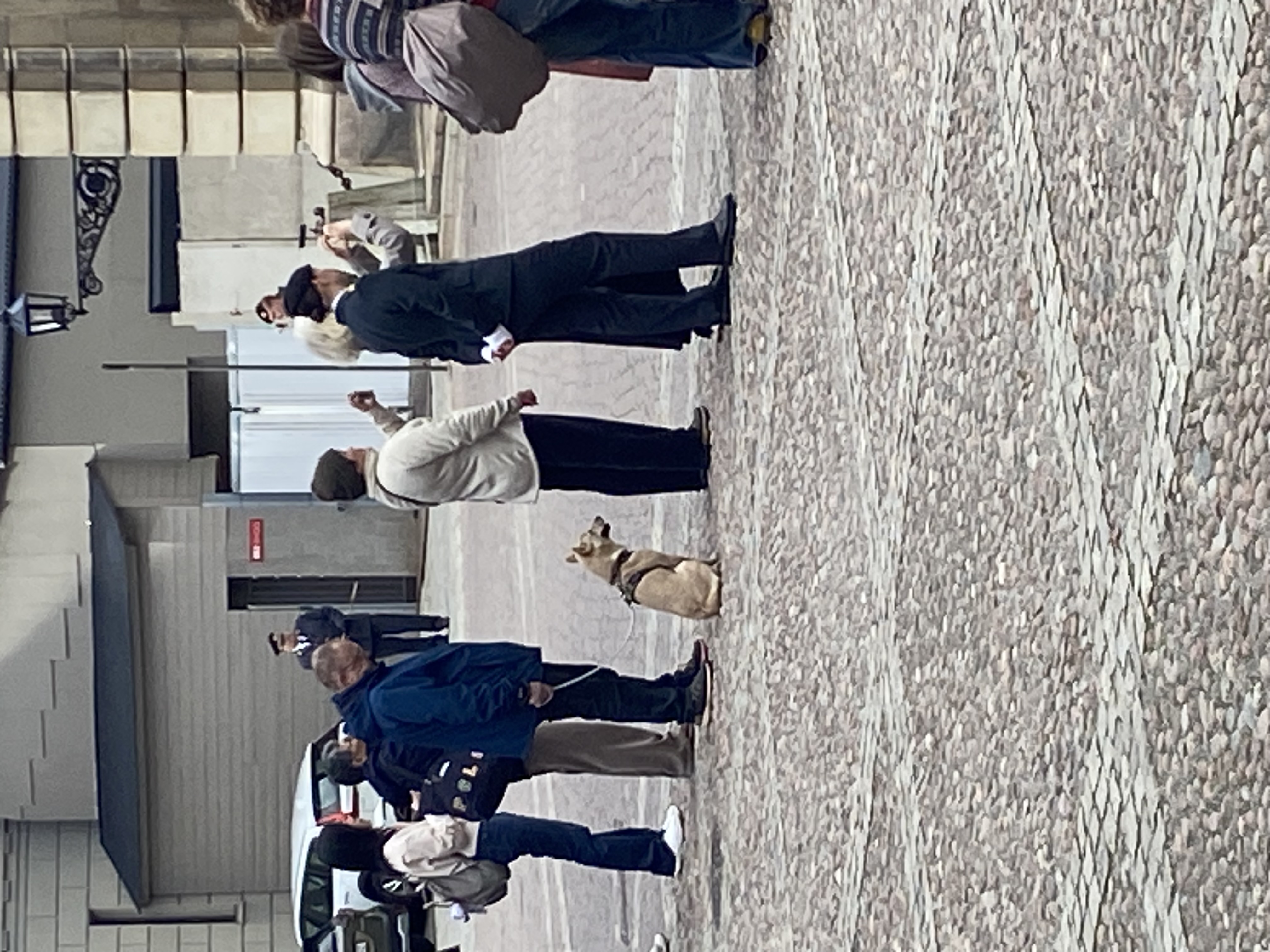
Our little four-legged responder.
The Pleasures of an Irregular City
For me, Stockholm’s greatest pleasure was simply walking around.
The irregular street pattern creates countless opportunities for interesting public spaces. Streets meet at odd angles, leaving triangular plots, little plazas, and unexpected pockets of greenery. Some become gathering places, while others are simply planted with flowers, shrubs, or trees.
I particularly enjoy cities where streets aren’t entirely predictable. In a rigid grid, you generally know what’s coming. In Stockholm, you might round a corner and discover a wonderful building, a charming little square, or a view across the water toward another island.
The relationship between the buildings and the streets is particularly appealing. Even many of the grandest buildings maintain a comfortable pedestrian scale. You can appreciate their architectural details without having to stand half a mile away.
Stockholm is certainly more monumental than Gothenburg. As Sweden’s capital, it has the palaces, government buildings, and grand civic architecture you’d expect. But much of the city remains remarkably walkable and inviting.
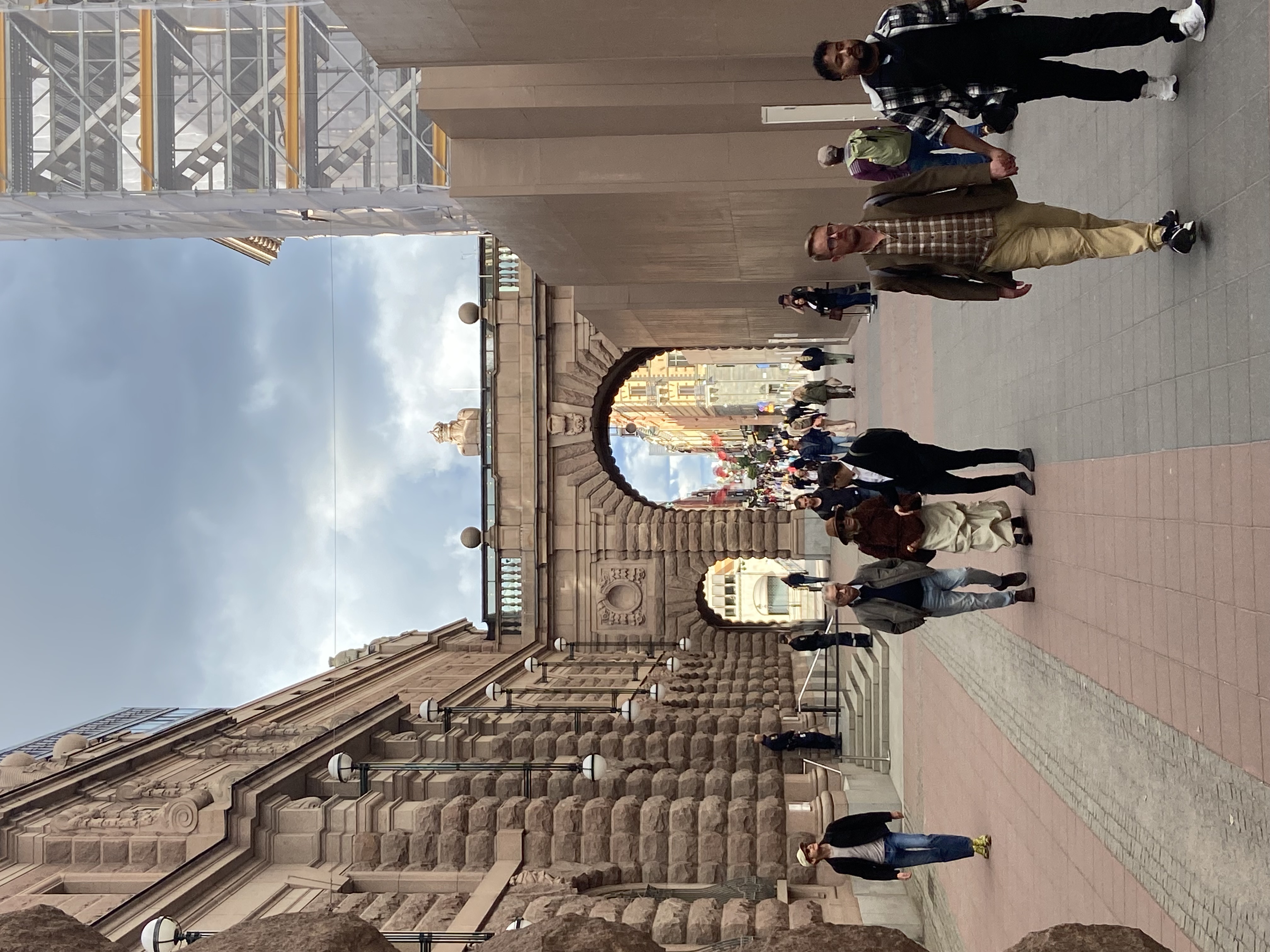 Stockholm’s irregular streets, passageways, and unexpected public spaces make walking around a pleasure.
Pedestrians, Drivers, and the Fine Art of Crossing the Street
I noticed some interesting differences in pedestrian behavior among the three cities we visited.
In Helsinki, drivers were extraordinarily respectful of pedestrians. Cars routinely stopped well before crosswalks, and pedestrians seemed equally committed to obeying the signals. Even when there wasn’t a vehicle in sight, people generally waited for the light to change. Gothenburg was similar.
Stockholm was a little different.
Drivers seemed just a wee bit impatient, occasionally nudging into pedestrian crossings. Pedestrians behaved differently, too. They were definitely more willing to cross against the signal. I confess that was a relief. I’m an inveterate “If the traffic ain’t coming, why wait for the signal to change?” kind of pedestrian. Every time I jaywalked in Helsinki or Gothenburg, I felt kinda guilty! So I pretty much curbed that habit. I have no objection to obeying traffic laws, but when there’s absolutely no traffic approaching, standing at an empty intersection waiting for permission to cross just seems silly.
Stockholm from the Water
If you’re visiting Stockholm, I highly recommend taking a boat tour around the central islands. It’s one of the best ways to appreciate the city’s geography and architecture. The boats travel through the waterways surrounding the central islands, providing perspectives you simply can’t experience from the streets.
We took a roughly two-hour tour operated by Strömma, one of Stockholm’s established sightseeing companies. Our tickets were approximately $40 each.
If you’ve ever taken the Chicago River Architecture Cruise, you’ll understand the appeal. In Chicago, the river provides a wonderful vantage point for appreciating the city’s extraordinary collection of skyscrapers.
Stockholm offers a similar experience, but with an entirely different architectural vocabulary. Instead of modern towers of glass and steel, you’re looking at centuries of richly ornamented buildings, elaborate rooflines, monumental civic structures, and magnificent waterfront residences. And, of course, all those domes and spires.
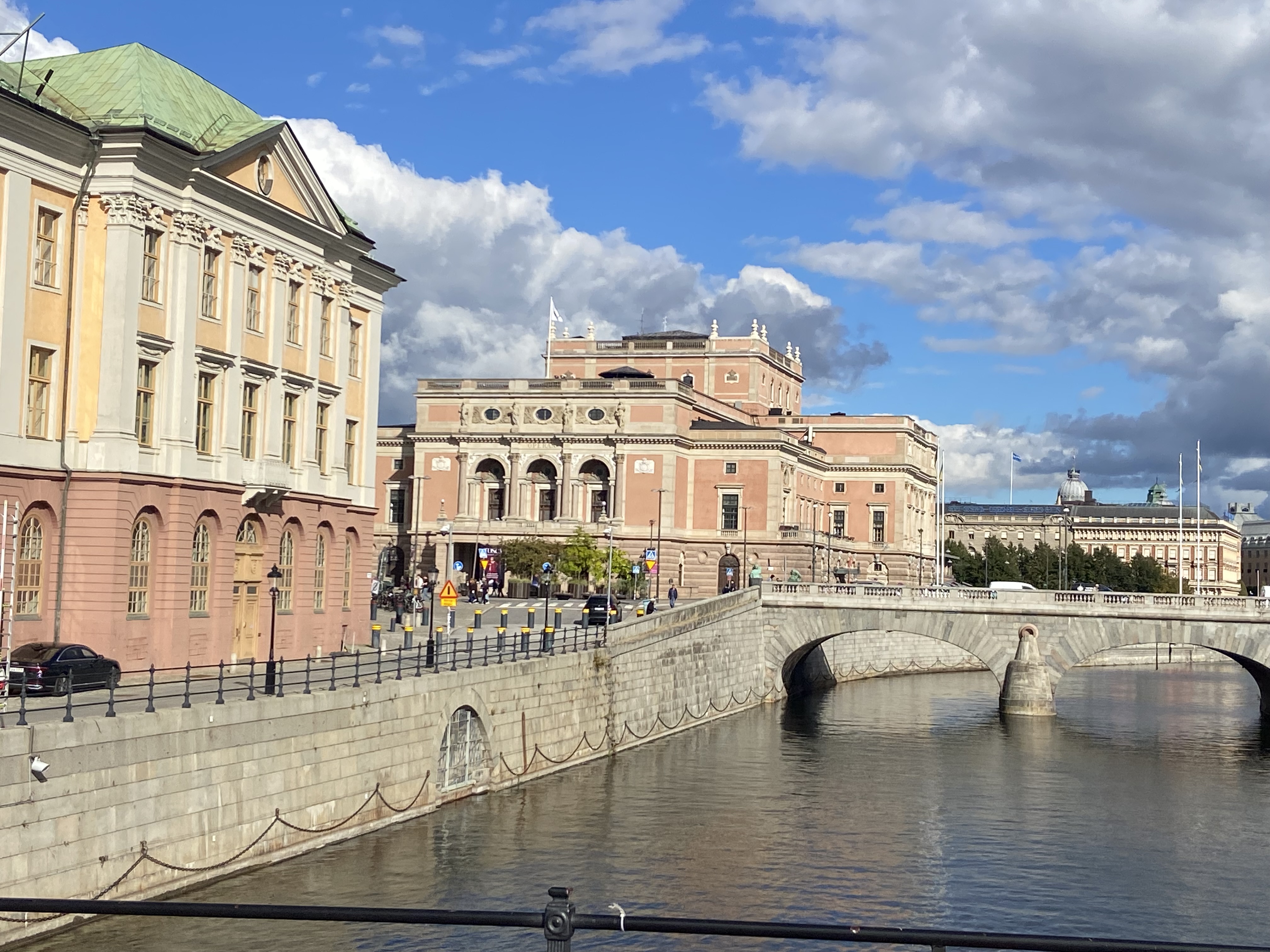
Stockholm’s grand waterfront architecture, viewed from the water on a glorious sunny day.
Some people call it the “Venice of the North.” I wouldn’t disagree.
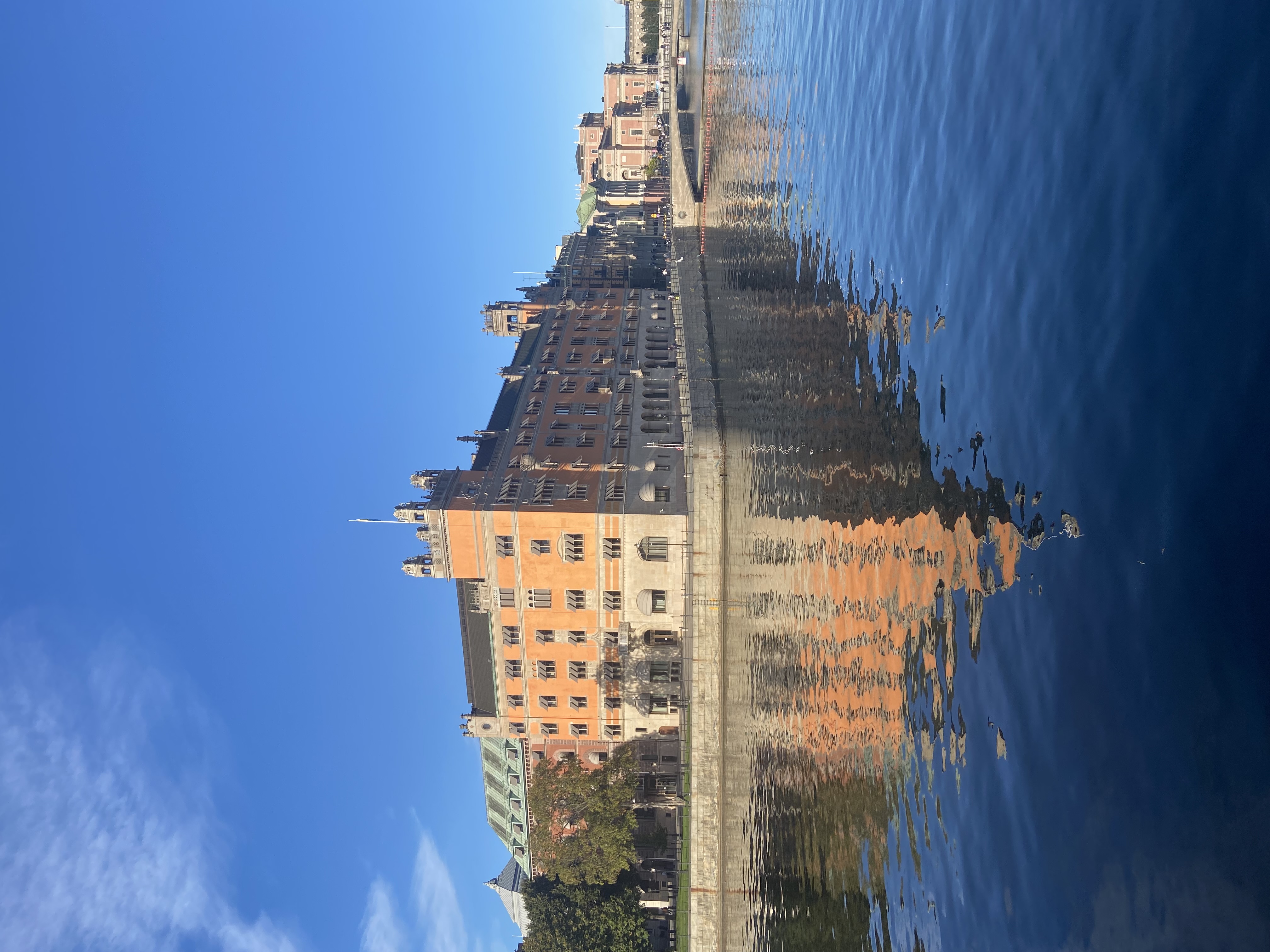
Another magnificent waterfront view. Stockholm’s islands and waterways are essential to understanding the city’s character.
A Hotel Designed for Looks. Living in It Is Another Matter.
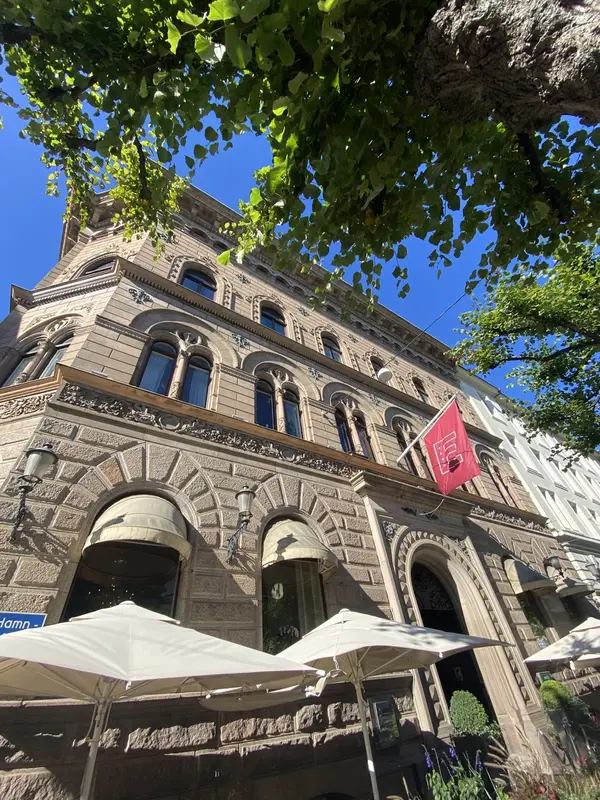
We stayed at the NOFO Hotel in Södermalm, a fashionable boutique hotel with an eclectic, contemporary design.
It had plenty of personality, and the public spaces were attractive. But lets face it: designers often become so enamored with appearances that they forget people actually have to use the things they design.
For starters, there was only one small trash can, located in the bathroom. I realize this may sound like a trivial complaint, but I’m forever accumulating little things that need to be discarded: receipts, tickets, maps, food wrappers, and whatever else ends up in my pockets.
A wastebasket near the desk or table would have been enormously helpful.
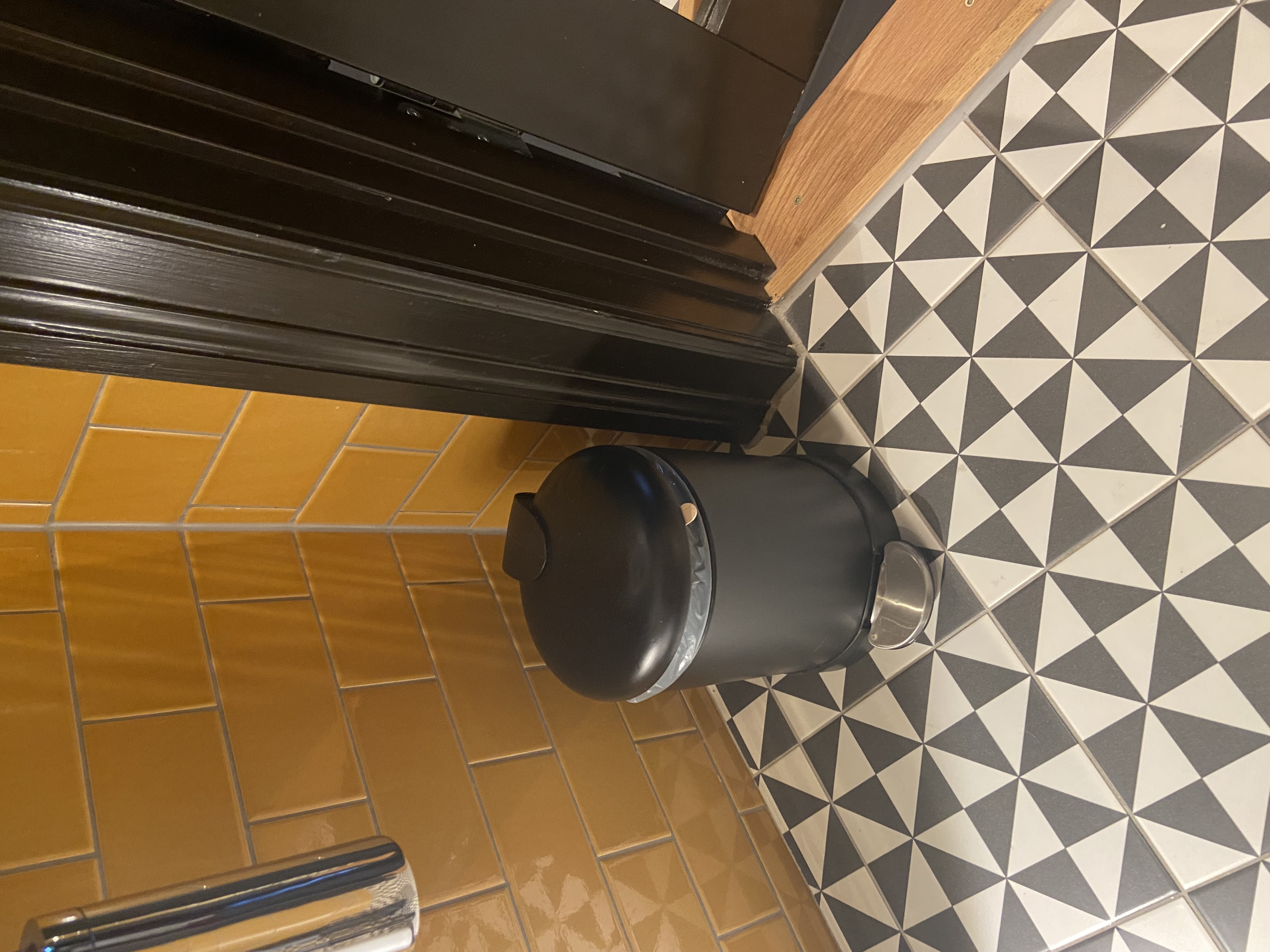
Our itty-bitty, totally inadequate trash can.
The wardrobe presented another challenge. Its interior was black, and there was no internal lighting. Combined with the room’s rather limited illumination, finding clothing became an unnecessarily complicated exercise.
I often find myself looking at fixtures and furnishings through my mother’s eyes. She had a practical question about almost everything: “Wouldn’t that be difficult to clean?”
A mother’s voice never goes away.
That pretty much sums up the overhead light fixture in our room. It was essentially a mass of irregularly shaped, squished wire mesh. It looked interesting, certainly. But how would you dust it? A feather duster? A vacuum cleaner? A small army of very patient people with toothbrushes? I suspect I’m a bit of a buzzkill when it comes to contemporary design. But if snazzy design doesn’t work well with human functioning, it’s just not good design. Design should accommodate the people who have to live with it.
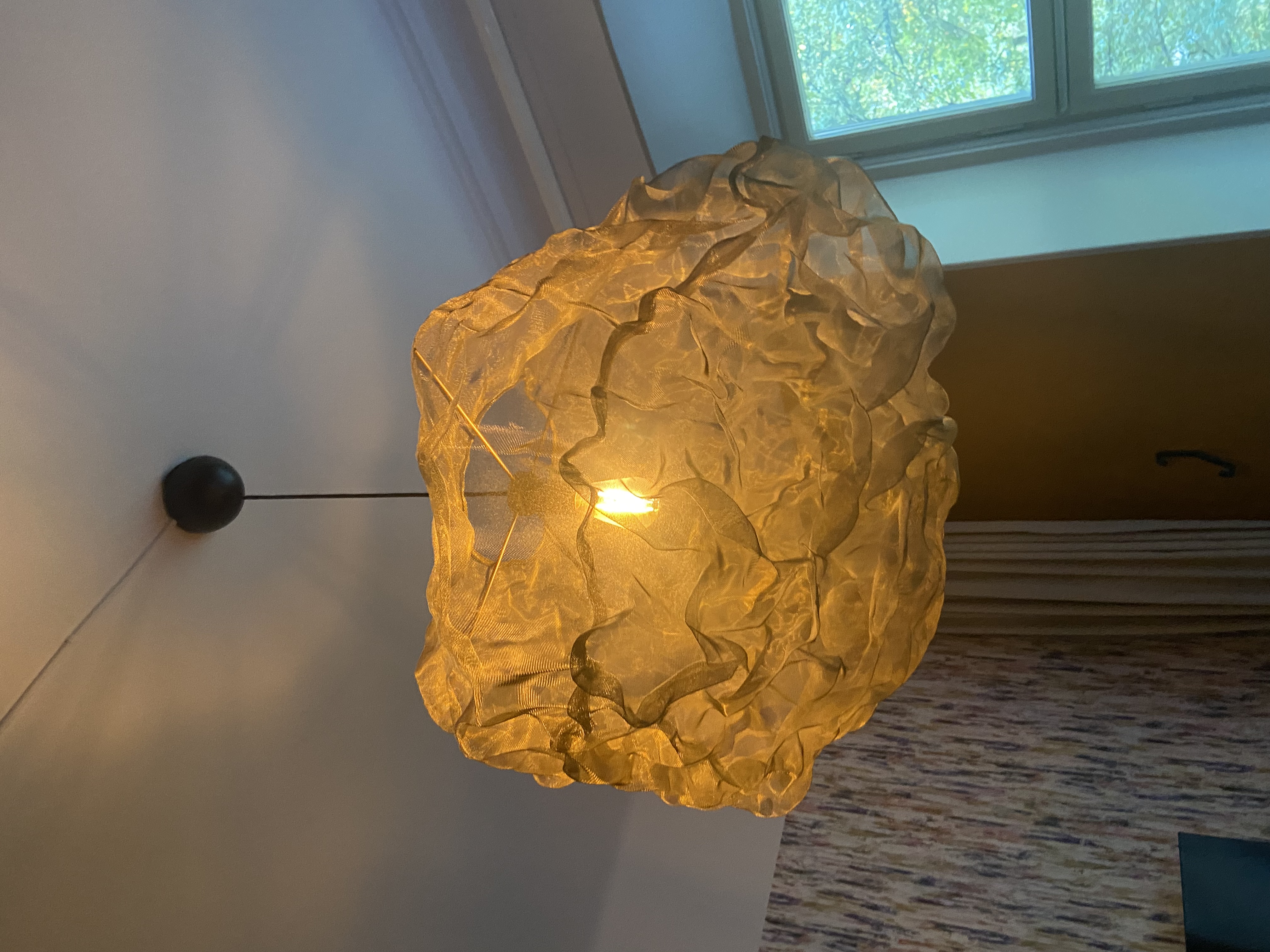
The overhead light in our hotel room. Made of irregularly shaped wire mesh. How are you supposed to clean the darn thing?
And don’t get me started on the electrical outlets.

More design that favors appearance over function. This dark electrical outlet was near the floor, and finding the openings required getting down on my hands and knees. Grrr.
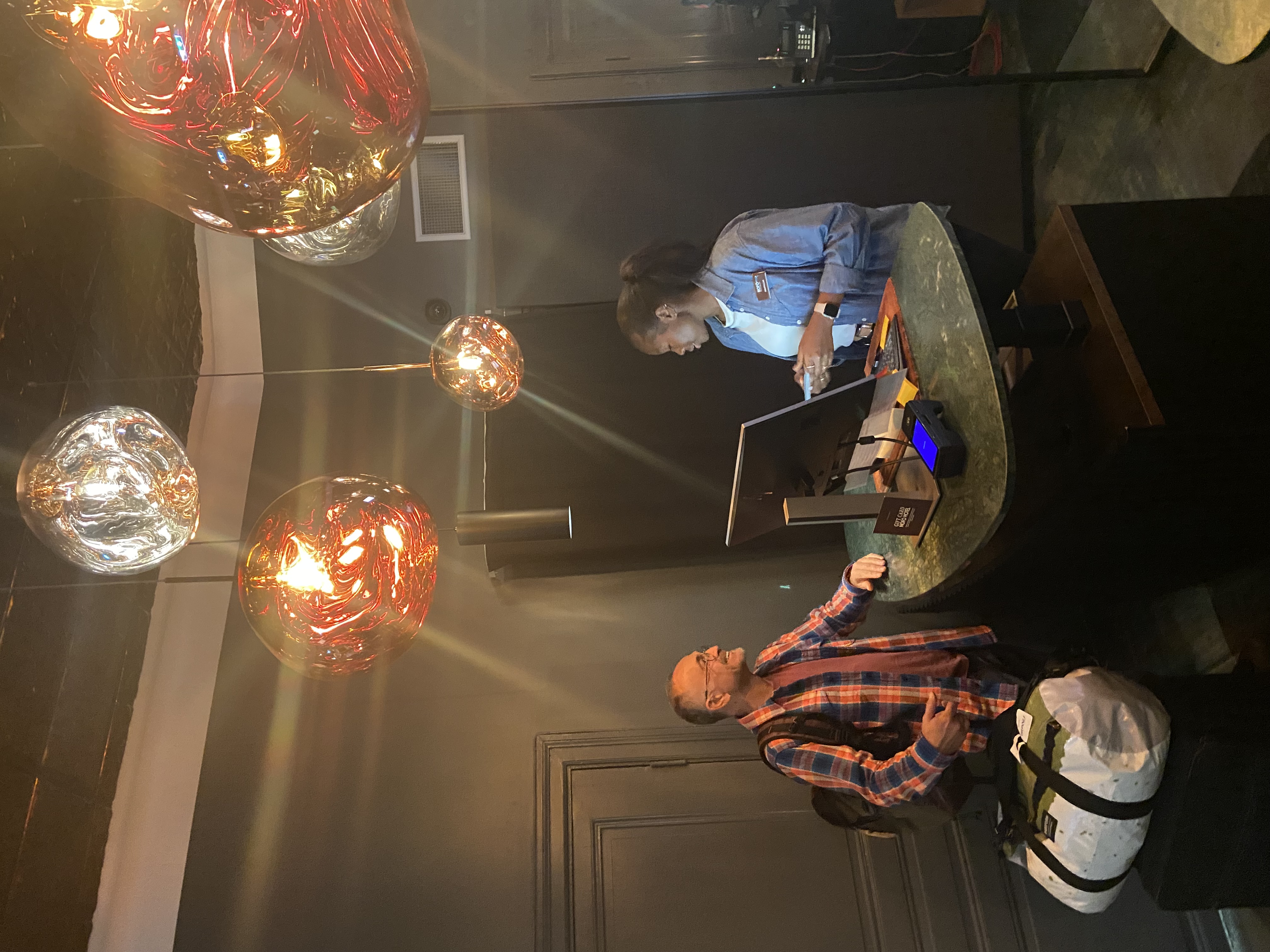
The lobby of the NOFO Hotel. Attractive, eclectic, and full of personality. And it was much darker than this photo suggests.
Below: Through this arch into the hotel!
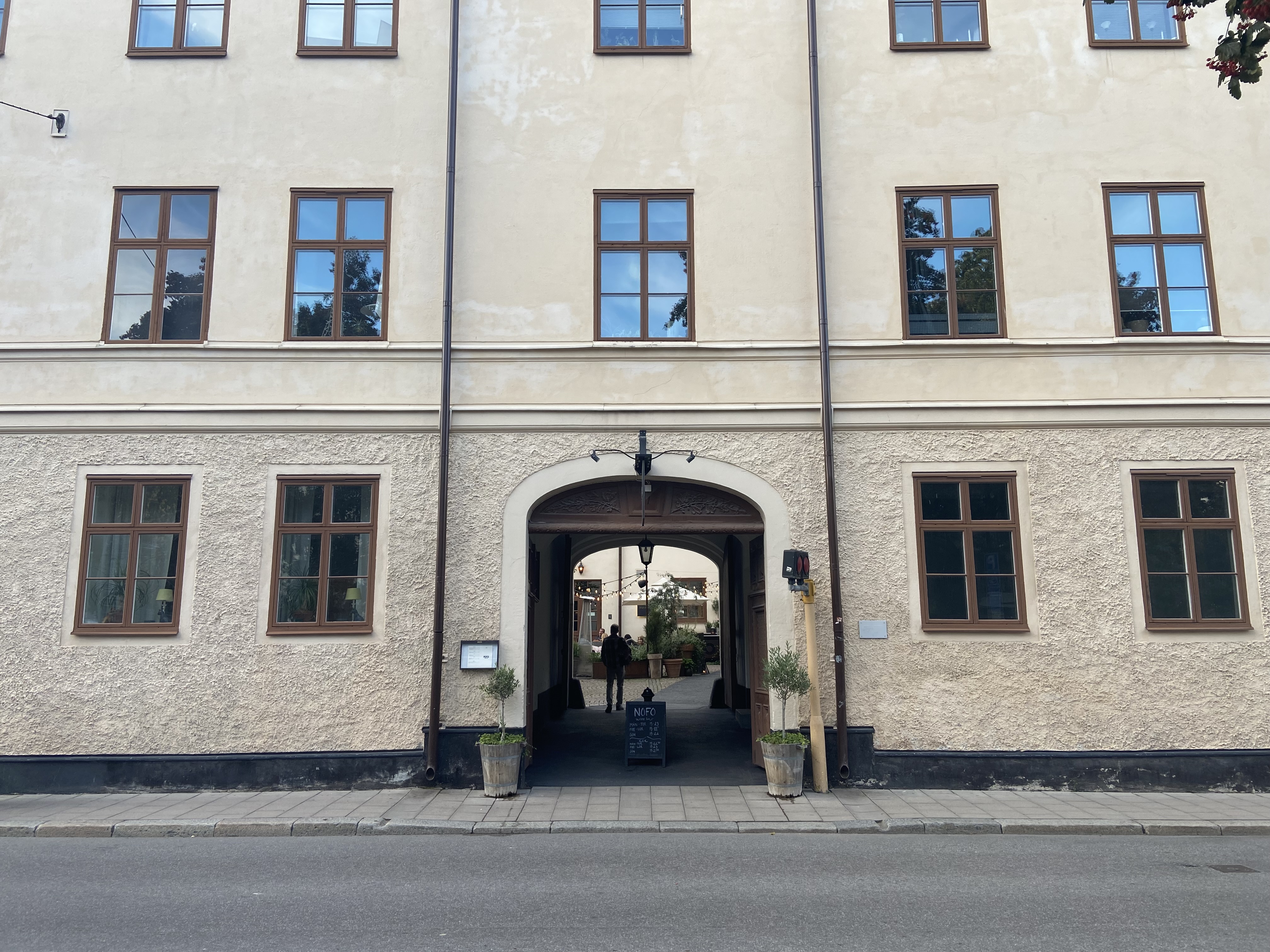
Markets, Mushrooms, and Everyday Stockholm
We came across a wonderful outdoor market with stalls selling fresh produce, berries, and mushrooms. And what mushrooms!
There were beautiful displays of chanterelles, those golden, trumpet-shaped mushrooms prized for their delicate flavor. They were piled high in baskets, alongside other varieties I couldn’t begin to identify. The colors and abundance were irresistible.
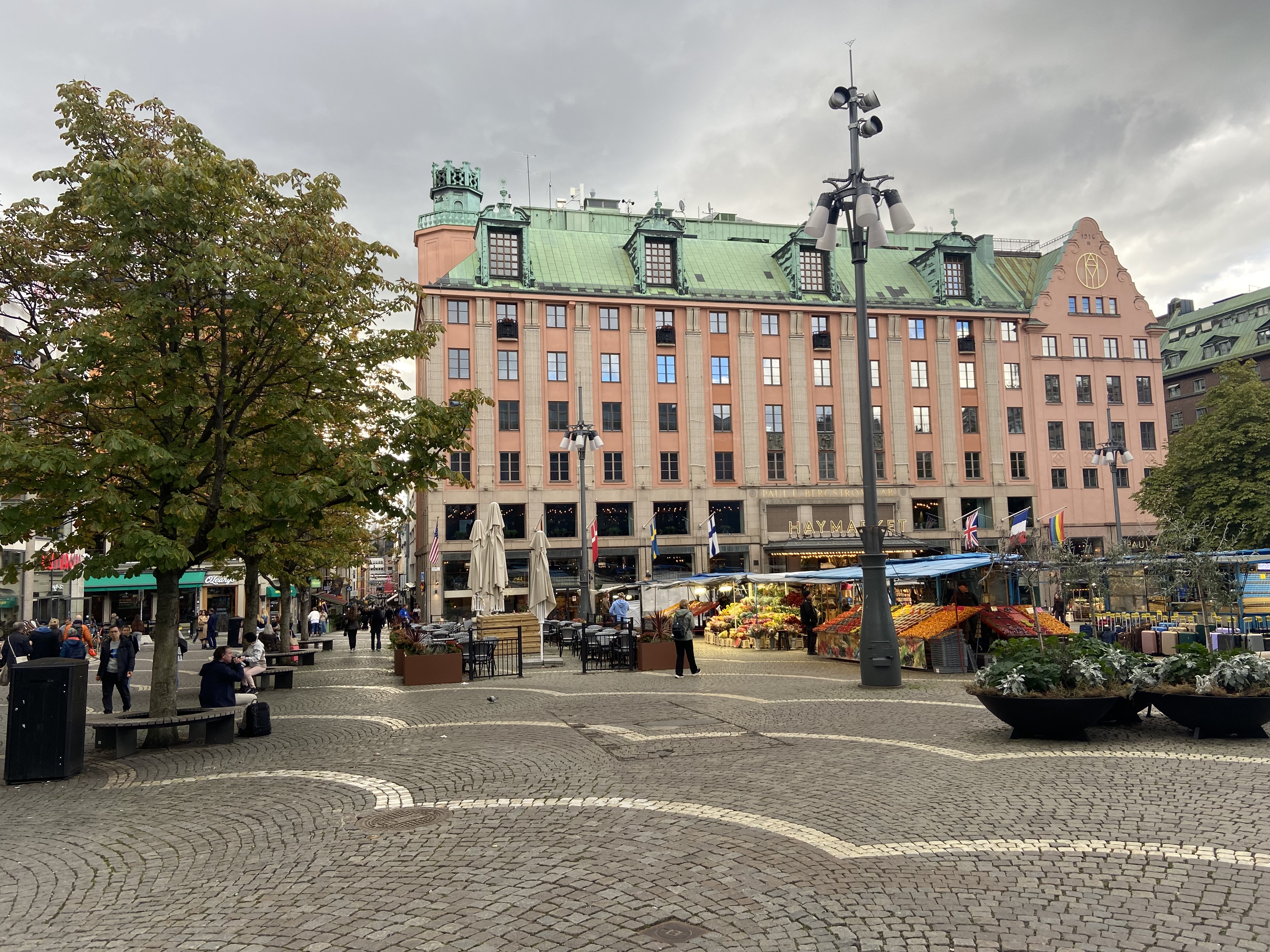
Fresh produce, flowers, and an extraordinary assortment of mushrooms at Stockholm’s Hötorget market.
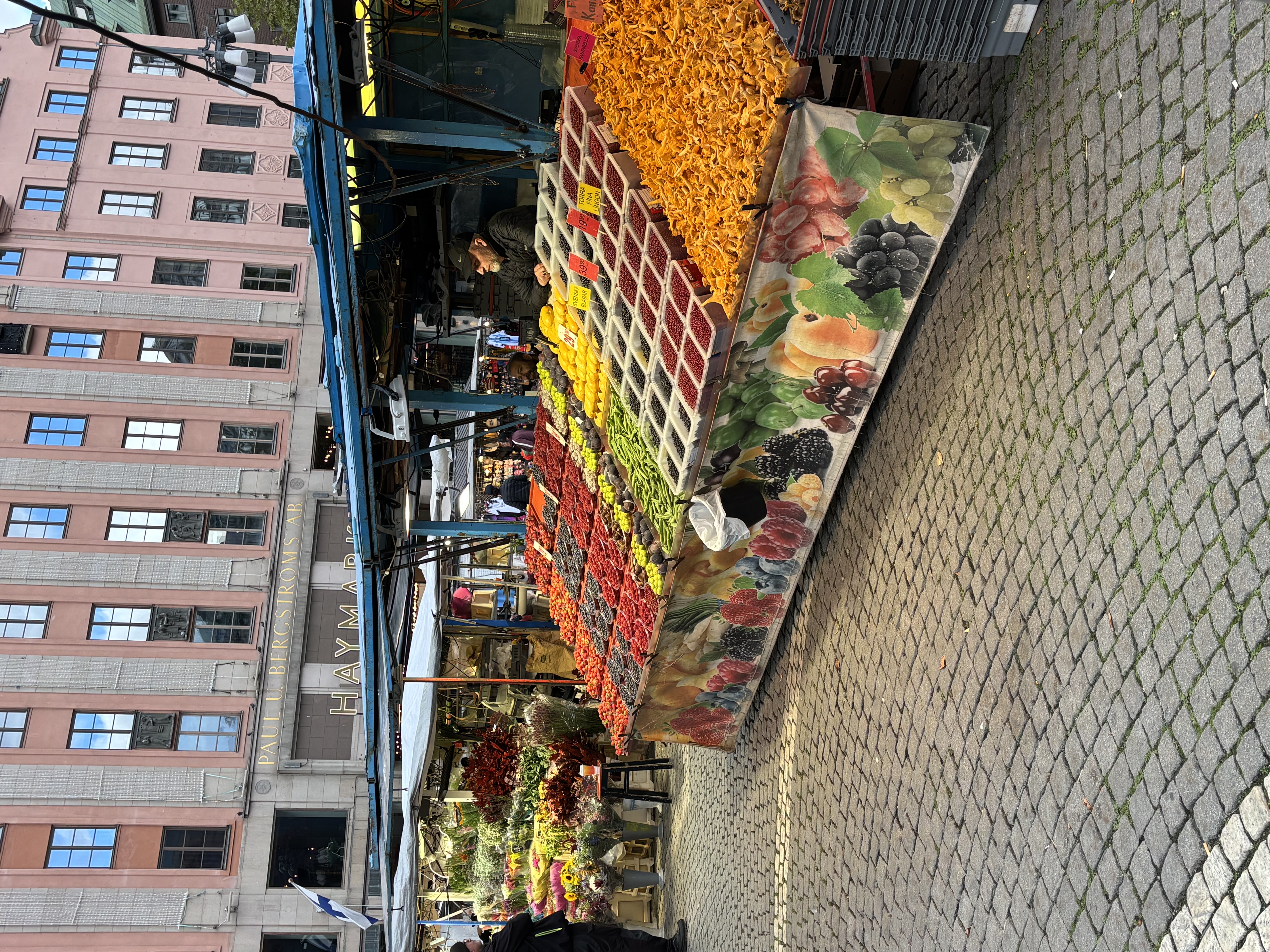
Locally grown fresh produce.

Check out these chanterelles! The Swedes take their mushrooms seriously.
Witches, Churches, and Some Unpleasant Swedish History
Stockholm has its share of darker history, including the witch trials that swept through parts of Europe during the seventeenth century.
Sweden experienced a particularly intense period of witch persecution known as Det stora oväsendet, or “The Great Noise,” between 1668 and 1676. We learned that the Katarina parish in Södermalm, where our hotel was located, was closely associated with Stockholm’s witch trials during the 1670s. Accusations frequently involved claims that witches had transported children to Blåkulla, a mythical gathering place associated with the Devil. Testimony from children played a significant role in the prosecutions. The hysteria eventually subsided, but not before numerous people had been executed.
Today, Katarina Church is a beautiful landmark in an attractive neighborhood. The present church was completed after the witch trials, although its parish is closely connected to that troubling chapter of Stockholm’s history. I imagine you can practice witchcraft in Stockholm these days without attracting much official attention.
 The dome and cupola of Katarina Church in Södermalm. The surrounding parish has a particularly unsettling connection to Stockholm’s seventeenth-century witch trials.
And Where Have All the SUVs Gone?
Here’s another observation that has absolutely nothing to do with architecture, although I found it nearly as interesting. There are a LOT of station wagons in Stockholm. And very few SUVs.
Volvo wagons were everywhere, naturally, but we also saw plenty of Mercedes-Benz, Volkswagen, Audi, and BMW wagons. Both my better half and I have a fondness for stylish station wagons, so we enjoyed seeing so many of them.
Stockholm, Gothenburg, and Helsinki: Three Very Different Cities
Each city—Helsinki, Gothenburg, and Stockholm—was distinctly different from the others.
Helsinki was the most restrained architecturally. Its urban character is shaped by a combination of Neoclassical, National Romantic, and modernist buildings, with an emphasis on simplicity, craftsmanship, and carefully considered design.
Gothenburg felt more intimate. Its historic center, pedestrian shopping streets, and inviting public spaces created a relaxed atmosphere that I found particularly appealing.
Stockholm was grander, more elaborate, and visually spectacular. Its architecture is closer in spirit to the great European capitals, with monumental public buildings, richly decorated façades, and all those domes, towers, and spires. Yet much of its historic center retains a comfortable pedestrian scale, with irregular streets, little squares, and changing vistas that make exploring on foot such a pleasure.
What I enjoyed most was the experience of moving through the city, discovering something unexpected around nearly every corner. Stockholm has an unmistakable identity. Its architecture, geography, and urban design combine to create a cityscape that couldn’t be mistaken for anywhere else.
For anyone who enjoys grand architecture, charming streets, and a city that rewards wandering, Stockholm is a wonderful destination. And if you’re lucky, you might even encounter a dog who thinks he should be commanding the royal guard.
Planning a Visit to Stockholm
Stockholm is an excellent city for travelers interested in architecture, history, urban design, and walkable neighborhoods.
Where to stay: Gamla Stan and nearby parts of Södermalm are convenient for exploring the historic center. Östermalm offers elegant streets, grand architecture, and access to many of Stockholm’s cultural attractions.
Where to explore: Much of the most interesting historic architecture is concentrated in Gamla Stan, Östermalm, and the waterfront areas connecting the central islands.
Don’t miss: The Royal Palace, Stockholm Cathedral, Stockholm City Hall, and a sightseeing boat tour.
Getting around: Central Stockholm is very walkable, although some neighborhoods have steep streets and substantial changes in elevation. Public transportation is excellent, including the metro, buses, trams, and ferries.
Boat tours: Strömma operates several sightseeing cruises. Tour routes, schedules, and prices vary by season, so check current information before booking.
Frequently Asked Questions About Stockholm
1. What makes Stockholm’s architecture unique?
Stockholm combines centuries of European architectural influences with distinctly Swedish traditions. Its historic buildings include Renaissance, Baroque, Neoclassical, Art Nouveau, National Romantic, and modernist examples. The city’s islands and waterways create dramatic views of its elaborate rooflines, domes, towers, and spires.
2. What are the best neighborhoods in Stockholm for architecture lovers?
Gamla Stan, Stockholm’s historic center, is especially appealing for its medieval street pattern, colorful buildings, intimate squares, and monumental landmarks. Östermalm features grand nineteenth- and early twentieth-century architecture, while Södermalm offers historic churches, interesting streets, and a more relaxed residential atmosphere.
3. Why does Stockholm have so many domes, towers, and spires?
Stockholm’s distinctive skyline reflects several centuries of architectural development. Churches, palaces, government buildings, and commercial structures frequently incorporated elaborate rooflines and towers. These features served decorative, symbolic, and sometimes practical purposes, including helping identify important buildings from a distance.
4. Is Stockholm a walkable city?
Yes. Central Stockholm is particularly enjoyable on foot, especially in Gamla Stan and the surrounding neighborhoods. Its irregular streets, small public squares, waterfront promenades, and historic architecture make walking one of the best ways to experience the city. Visitors should be prepared for some hills and cobblestone streets.
5. Is a Stockholm boat tour worth taking?
Absolutely, particularly for visitors interested in architecture and urban design. Stockholm’s islands and waterways provide perspectives of historic buildings, bridges, and waterfront neighborhoods that aren’t available from the streets. Several companies operate sightseeing cruises, including Strömma.
6. How does Stockholm compare with Helsinki and Gothenburg?
Stockholm feels grander and more architecturally elaborate than either Helsinki or Gothenburg. Helsinki is known for its restrained design traditions and distinctive modernist architecture, while Gothenburg offers a more intimate pedestrian experience. Stockholm combines monumental European architecture with historic streets, islands, waterways, and remarkable urban vistas.
7. Are chic hotels very functional?
If only.


GET MORE INFORMATION